

The right powertrain for a classic 4x4 depends less on the powertrain than on the driving. Both options are good. Both give something up. The useful question is which set of tradeoffs fits the weeks you'll actually spend in the vehicle, and that's a question about your life before it's a question about engineering.
Start with the driving you actually do
Describe an ordinary month with the vehicle. Is it a daily commute with a trailhead on Saturday? The ski lot every weekend from December to March? Long trips on two lane highways where the next town is a long way off? A slow, rocky trail where you're picking a line at walking pace?
Each of those leans somewhere. None of them settles it alone, and the vehicle matters too. A short FJ40 and a long Defender wagon use their space differently, and how you'll load them for a trip is part of the picture.
Climate counts as well. A vehicle that lives through an Idaho winter, parked outside a ski area in the cold, asks different things of its powertrain than one that spends its life on summer back roads.
What a crate engine keeps
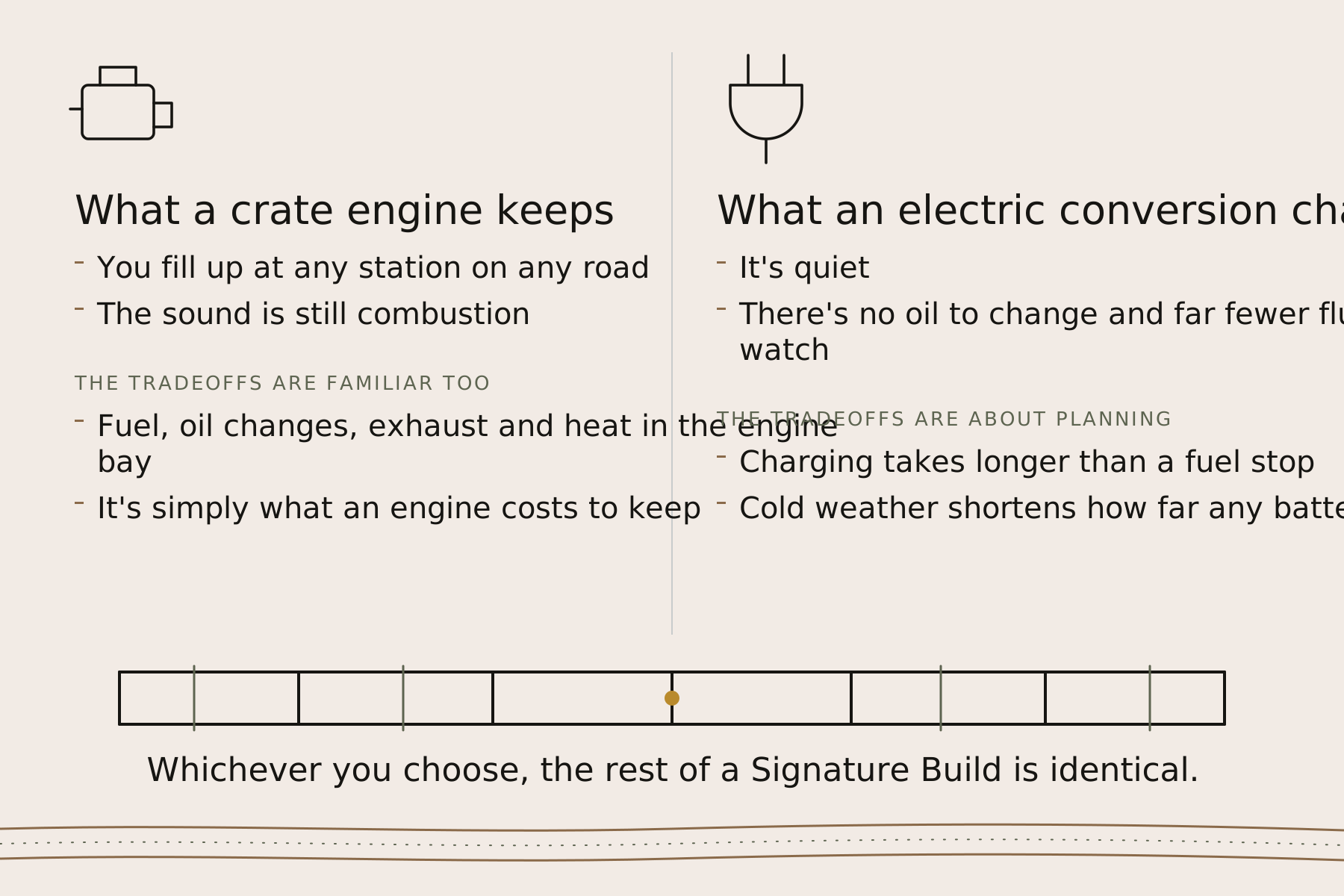
A modern crate engine keeps the parts of ownership people already understand. You fill up at any station on any road. Your range is the size of the tank and the weight of your right foot. The sound is still combustion, which matters more to some owners than they expect, and a mechanic in a small town far from home will recognize what's under the hood. It's also closest to how these vehicles first lived, a long way from anywhere and refueled from whatever was available.
The tradeoffs are familiar too. Fuel, oil changes, exhaust and heat in the engine bay all come with it, along with the routine servicing any engine asks for. None of that is a mystery. It's simply what an engine costs to keep, and plenty of owners like it that way because they know exactly where they stand.
What an electric conversion changes
A full electric conversion changes the character of the vehicle far more than its looks. It's quiet: you hear the tires on gravel and the wind over the roof. Electric motors deliver their pull from a standstill, which suits slow trail work where you want fine control at walking pace rather than revs. There's no oil to change and far fewer fluids to watch. For a vehicle that spends most of its life on errands, commutes and trailheads within a day's reach, it can be the calmer way to own a classic.
The tradeoffs are about planning. Charging takes longer than a fuel stop, chargers are thinner on the ground near trailheads and ski areas than gas stations are, and cold weather shortens how far any battery goes. For many owners that hardly matters, because the vehicle spends its nights where it can be plugged in. For someone crossing empty country, it's the whole question.


Where the two end up the same
Whichever you choose, the rest of a Signature Build is identical. The body and chassis are stripped, restored, corrosion proofed and strengthened. Suspension, steering and brakes are brought up to contemporary expectations. The interior gets modern seats, climate control and sound insulation without losing the period look. And the vehicle is looked after by the shop that built it for its whole life, as paid ongoing work, whatever sits under the hood.
From the curb the two look the same, because the period look is the reason to own a classic 4x4 and both powertrains are built around keeping it. So this is a choice about how the vehicle feels and how you'll refuel it. Everything around the powertrain is built to one standard, and Duncrest offers both as equals, with neither preselected.
Questions worth bringing to the consultation
The decision is yours, and the free consultation is where it gets made. A few things are worth knowing before you sit down:
- The longest drive you make regularly, and how often you make it.
- Where the vehicle sleeps at night, and whether there's power there.
- How much of your driving is slow trail work and how much is highway.
- Whether the sound of an engine is part of why you want a classic at all.
- Who else will drive it, and what they're used to.
You'll notice there isn't a single range, power or performance figure in this article. That's deliberate. Those depend on the vehicle and the build, and they belong in the conversation about yours rather than in a general piece written for everyone.
Choose the powertrain that suits the driving. The rest of the build doesn't change. If you're still torn, pick Not sure yet when you draft your build sheet. It's a perfectly good answer to bring to the first conversation.