
The engine is the least important part of a donor vehicle. In a restomod it's coming out anyway, replaced by a modern crate engine or a full electric conversion, so a tired motor that smokes on a cold start tells you very little about whether the truck is worth buying. What matters is what stays: the frame, the body shell and the paperwork that says which vehicle it is.
Most sellers know this. Most listings still lead with the engine. Read past it.
Rust keeps to a pattern on each model
These vehicles were built to be fixed in the field, and decades of water, road salt and mud have found the same weak points on most of them. That's good news for a buyer. It means you can read a donor in an afternoon if you know where to look, and you don't have to take anyone's word for its condition.
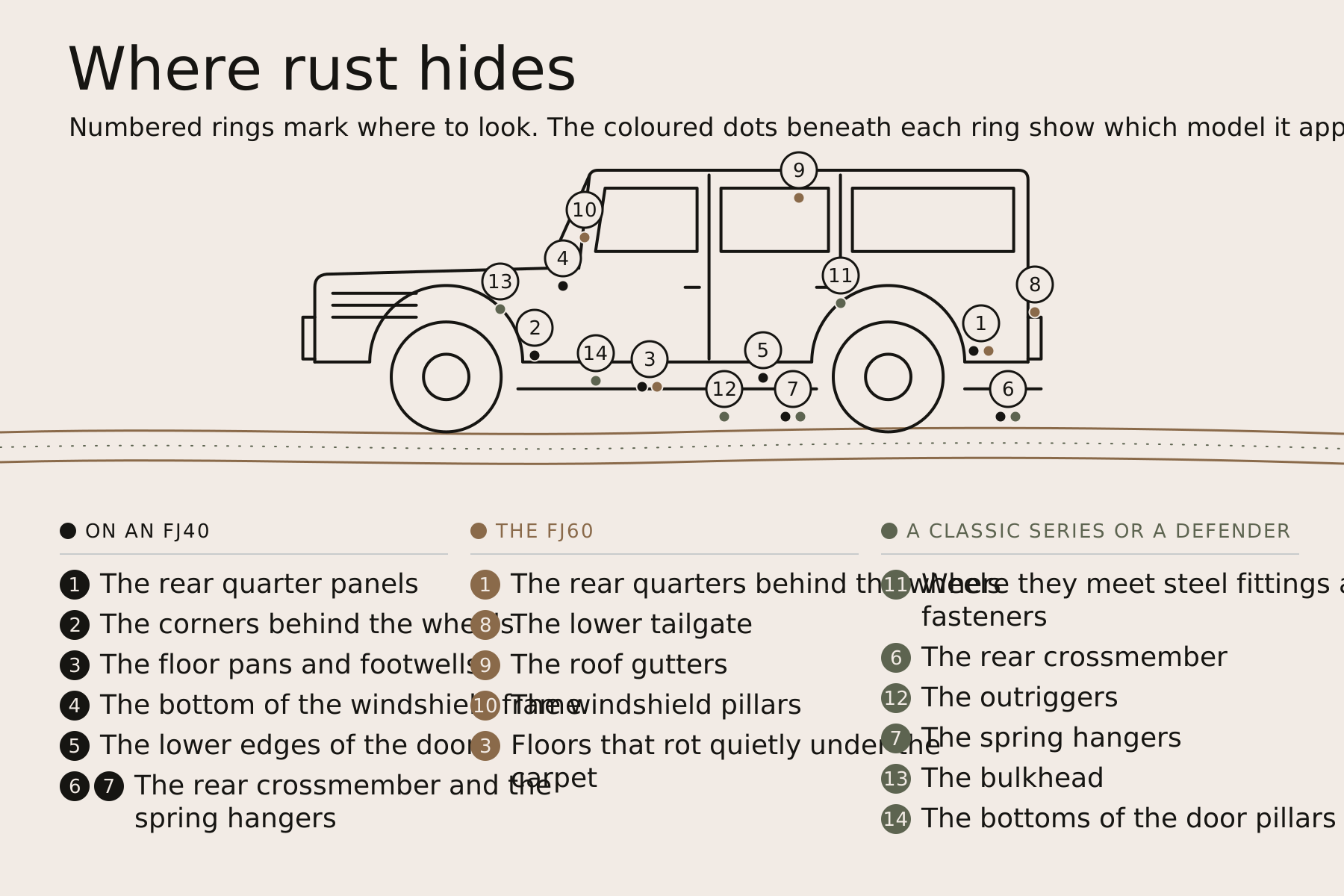
On an FJ40, start at the back. The rear quarter panels and the corners behind the wheels tend to go first, then the floor pans and footwells, the bottom of the windshield frame and the lower edges of the doors. Underneath, look hard at the rear crossmember and the spring hangers. Surface rust on a frame is normal for its age. Scale that comes away in sheets, or a screwdriver that pushes through where it shouldn't, is a different conversation.
The FJ60 is a bigger wagon with its own habits: the rear quarters behind the wheels, the lower tailgate, the roof gutters, the windshield pillars, and floors that rot quietly under the carpet. Lift the carpet. Sellers rarely do it for you.
A 70 Series in the United States is almost always an import, brought in once it was old enough to qualify. Ask where it lived before it arrived, because a truck from a dry climate and a truck from a coastal one can look identical in photographs and be nothing alike underneath.
A classic Series or a Defender changes the problem. Most of the body panels are aluminum, so they don't rust the way steel does, but they corrode where they meet steel fittings and fasteners. The chassis is steel, and it rots at the rear crossmember, the outriggers and the spring hangers. The bulkhead, the steel panel between the engine and the cabin, goes at the footwells and the bottoms of the door pillars. A sound chassis can be found with patience. A rotten bulkhead is a bigger job than it looks from the driver's seat.
A frame can be rebuilt, and a history can't
Here's the part people skip. Almost any body can be repaired by a shop with the right tools and enough time, and a frame off rebuild exists precisely because old steel needs it. What nobody can manufacture is the vehicle's identity.
Check that the number on the frame matches the number on the title, and that both match any plate on the body. On an older Land Cruiser that number predates the modern 17 character VIN and reads as a model code followed by a serial. A Defender built for North America carries the full 17 character format. A mismatch isn't always a scandal, because old trucks have had frames swapped for decades. It is always a question, though, and the answer should be on paper before you pay.
For an import, ask for the import documents as well. A truck that arrived legally has a paper trail that shows it, and a seller who can't produce one is telling you something.


Why fresh paint on a donor should slow you down
A freshly painted donor is the hardest kind to read. Filler and paint cover a great deal, and a restomod strips all of it off again, so you'd be paying for work that gets thrown away and that may be hiding the very thing you needed to see.
The better buy is often the honest one: original paint, visible surface rust, a tired interior, and a seller who lets you crawl underneath with a flashlight and a magnet. A magnet that won't stick to a steel panel has found filler. Bring one.
Price follows the same logic. What you pay for a donor is mostly what you pay for the frame, the shell and the paperwork. Spend for those. Let the engine and the seats go cheap, because a Signature Build replaces both.
Where the free donor search fits
You don't have to do this alone, and asking costs nothing. If you haven't found a vehicle yet, the donor search conversation with Duncrest is free. Say which one you're after, whether that's an FJ40, an FJ60, a 70 Series, a Series or a Defender, and the search starts there.
If you already own one, bring it into the same conversation. It gets read the same way, frame and shell and paperwork first, and you'll know what it would take before any money changes hands.
Judge a donor by what survives the rebuild. Everything else is going to change.
If you've found a truck and want a second opinion before you buy it, start your build and tell us about it.