

Most restomod estimates are written before anyone has seen the bare frame. That's the root of nearly every story about a budget that ran away, and it isn't always anyone's fault. A forty year old vehicle hides its condition under paint, undercoating and decades of repairs, and the honest answer to "what will it cost?" is often "we'll know when it's apart."
The trouble is what happens after that. Owners trading notes on the enthusiast forums talk about budgeting fifteen or twenty percent over the estimate as though it were a law of physics. They describe bills that arrive in pieces, a rust repair here and a better axle there, and they have a phrase for it: being nickel and dimed.
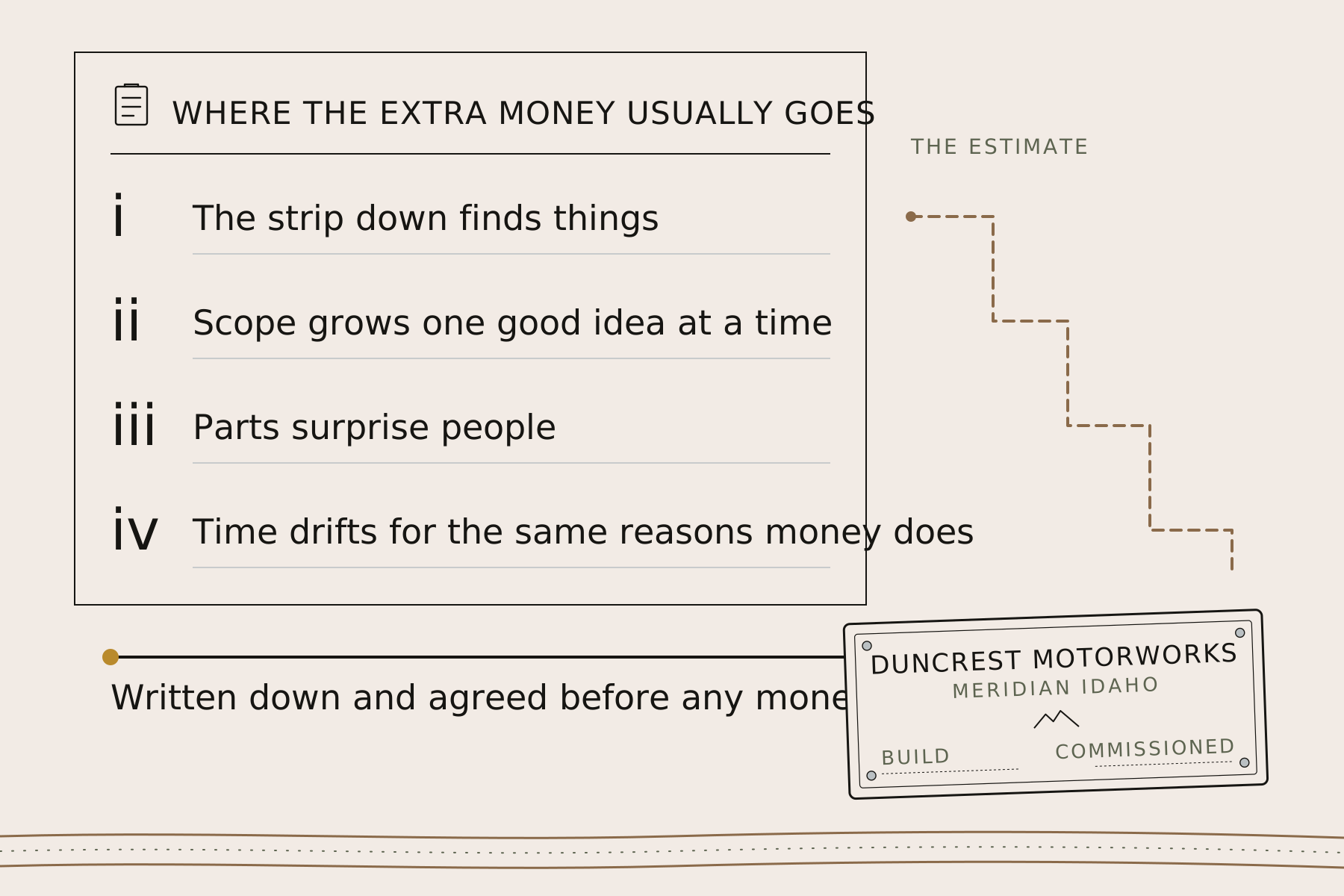
Where the extra money usually goes
Most overruns come from a short list.
The strip down finds things. Rust is the obvious one, and it's rarely only where anybody could see it. A rear crossmember that looked sound from underneath can be thin from the inside. A floor that seemed solid under the carpet can turn out to be a patch over an older patch.
Scope grows one good idea at a time. Once the body is off, it's tempting to do the brakes properly, then the steering, then the wiring, then the seats. Each step makes sense on its own. Added together, they make a different build from the one that was priced.
Parts surprise people. Some original parts for these vehicles are scarce or simply gone, and the replacements cost what scarcity costs.
Why the calendar slips along with the bill
Time drifts for the same reasons money does. Every surprise in the steel adds a repair and a wait. Every addition to the scope adds parts to order and work to schedule. A shop running many open ended builds at once has every reason to keep starting new ones, and owners on those same forums describe waiting years longer than they were told.
That's why Duncrest doesn't publish a build time on its website. Timing is a question for the consultation, asked plainly and answered before you commit to anything.


What a build sheet changes before work starts
A build sheet is the scope of a build, written down and agreed before any money changes hands. At Duncrest it follows a free consultation and sets out the vehicle, the build level, the powertrain and what the build includes. Every build starts at $100,000, and the sheet is where your build's own price is set.
Writing the scope first does two useful things. It makes the expensive decisions while they're still cheap, across a table rather than in the middle of a strip down. And it gives you and the shop the same page to refer back to, so any later conversation starts from an agreed list instead of from a blank invoice.
What a build sheet still leaves to the steel
A sheet can't make old steel honest. If stripping a body finds something nobody could have seen, it still has to be dealt with, and anyone who promises otherwise about a vehicle this old is guessing. What the sheet changes is the shape of that moment. It becomes a discussion about one item measured against an agreed scope, which is a very different thing from a bill that simply keeps growing.
Aftercare belongs in the same first conversation. Servicing, maintenance and warranty work on a Duncrest build come from the shop that built it, for the life of the vehicle, as paid ongoing work. Knowing that before the build begins is part of knowing what the vehicle will cost to own, and it's a cost most estimates leave out entirely.
What to ask any shop before you commit
Whoever builds your vehicle, a handful of questions tell you most of what you need to know about how the money and the calendar will behave.
- Is the scope written down and agreed before you pay anything?
- What happens, in practice, when the strip down finds something new?
- How is timing discussed, and who tells you when it changes?
- Who services the vehicle after delivery, and how is that priced?
- Is the build documented against the vehicle's own number?
A shop with clear answers has thought about the parts of a restomod that usually go wrong. A shop that hasn't thought about them yet will show it in how it answers.
The cheapest moment to make a decision about a restomod is before it starts. That's the whole case for writing the scope down first.
When you'd like to see what your own sheet would hold, start your build. The consultation costs nothing.